
Delhi's air quality deteriorated significantly on Monday, with areas like Dwarka, Mundka and Najafgarh recording an AQI of 500, the worst this season. The city's overall AQI reached 491, triggering the implementation of the Graded Response Action Plan (GRAP) Stage-IV restrictions in Delhi-NCR. Doctors warned of health risks, urging people to wear N95 masks and avoid outdoor activities. The Supreme Court questioned the Delhi government on its anti-pollution measures and warned against scaling down preventive measures without its permission. Delhi Chief Minister Atishi accused the BJP-led central government of political maneuvering while neglecting stubble burning in states it governs. Meanwhile, the city enforced stricter pollution control measures, including a ban on truck entry and suspension of construction activities. Air purifier sales surged, reflecting the public's concern over the severe air pollution.

Light to moderate rain in many areas with heavy rain at isolated places is likely to occur in West Bengal's coastal districts of North 24 Parganas, South 24 Parganas and Purba Medinipur.

Increased production of pulses, oilseeds, and cereals will help boost domestic supplies and contribute to keeping inflation low in the coming months.

While rain intensity reduced on Tuesday compared to a day ago, affecting mainly districts in the Saurashtra region, administration carried out rescue and relief operations on a large scale, shifting thousands of people to shelters.

Several areas of Tamil Nadu remain inundated after hours of heavy to moderate rainfall in the region. Water entered houses and markets in the low-lying residential areas of Erode district due to heavy rainfall throughout the night.

Mohapatra said there is a 40 per cent chance of a normal rainfall, 22 per cent above normal, 12 per cent excess and 18 per cent below normal.

Villpuram district in north Tamil Nadu continued to reel under unprecedented flooding on Monday following extremely heavy rainfall, virtually blocking access to villages and residential colonies as bridges and roads overflowed, inundating huge acreage of standing crops and leaving passengers stranded as rail and road traffic was hit.

Andhra Pradesh Chief Minister N Chandrababu Naidu and his Telangana counterpart Revanth Reddy visited some inundated areas in their respective territories.

This would be the second cyclonic storm in the Arabian Sea this year.

Hailstorms were reported at various parts of the national capital including Palam, Chilpighat and Ayanagar, the IMD said.

Moderate to rather heavy rains are likely at many places over all districts of coastal Tamil Nadu and Puducherry on Monday as a low pressure area would form over the Southwest Bay.

After making landfall near Puducherry on November 30, Cyclone Fengal weakened on Sunday, but torrential downpour under its influence paralysed the union territory, with the Army stepping in to evacuate stranded persons in inundated streets.

Heatwave conditions have been prevailing in Odisha since April 15 and the Gangetic West Bengal since April 17, according to the MeT department.

Heavy rains lashed Mumbai and its suburbs on Thursday, causing waterlogging on roads in some areas that led to traffic snarls and also delayed local train operations.

Several deaths were reported across the country due to rain-related incidents like lightning strikes and drowning.

IMD Director General Mrutyunjay Mohapatra said that inducing artificial rain can only be attempted when there are clouds or moisture available.

A Regional Meteorological Centre bulletin said a cyclonic circulation is now seen over the Comorin area and its neighbourhood, extending up to mid tropospheric levels.

Temperatures in 17 locations breached 48 degrees Celsius on Monday, with the relentless heat affecting health and livelihoods across large parts of northwestern and central India.

The searing heat pushed the city's peak power demand to its highest for May, while the Delhi government directed the schools that have not closed for summer vacations to do so with immediate effect.

The southern districts of West Bengal, including Kolkata, woke up to light rain and an overcast sky on Monday as cyclone 'Sitrang' moved towards north Bay of Bengal, raising the likelihood of a downpour during the day and threatening to dampen Diwali festivities.

As heavy rains batter several parts of west and south India, the meteorological department on Friday said isolated extremely heavy falls are very likely over Konkan, Goa and central Maharashtra in the next two days.
Delhi's 24-hour average air quality index (AQI) stood at 248 on Saturday.

The mercury in Delhi, which recorded its hottest day of the year so far at 45.6 degrees Celsius on Sunday, came down to 42.4 degrees Celsius, according to the India meteorological department.

A sudden downpour in Delhi caught citizens off guard and caused heavy waterlogging and traffic jams on Tuesday while Mumbai breathed a sigh of relief as showers stopped a day after heavy rain brought the metropolis to its knees.

The IMD director said, the cyclonic storm Tauktae in the Arabian sea is moving away from the Kerala coast and is now approaching the Karnataka coast.

This is for the second time this month that Mumbai has recorded the highest maximum temperature in the country.

"The monsoon has reached Ratnagiri over the country's west coast. It will remain there for the week before moving on. This year's monsoon will be 96 per cent normal, with an error margin of 5 per cent," Indian Meteorological Department director B P Yadav said.

The threshold for a heat wave is met when the maximum temperature of a weather station reaches at least 40 degrees Celsius in the plains, 37 degrees in coastal areas, and 30 degrees in hilly regions, and the departure from normal is at least 4.5 notches.

Prime Minister Modi last week called for optimal grain storage, fire audits and mock drills in hospitals as preparations for the harsh summer forecast by the meteorological department.

The mean maximum temperature for the month of March was 28.2 degrees Celsius in 2020 and 2019. It was 32.8 degrees Celsius in 2018; 30.7 degrees Celsius in 2017 and 31.5 degrees Celsius in 2016, according to the India Meteorological Department data.
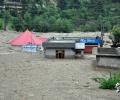
As the weather improved in parts of north India, which was pummelled by heavy rains for days, authorities on Wednesday worked on a war footing to rescue stranded tourists, restore vehicular traffic on arterial roads and prevent floodwaters from entering new areas.

Any long dry spell could cause moisture stress in the standing crop during the crucial maturing stage and also make it prone to pest and disease attacks.

IMD Director General Mrutunjay Mohapatra said the department's modelling indicate formation of a cyclonic storm around May 9, but its movement and intensification may be determined after the low pressure area actually forms on May 7.

Ten to 20 days of heatwave are expected against the normal of four to eight days in the entire April-June period.

An earthquake measuring 4.9 on the Richter scale hit Pakistan-occupied-Gilgit late on Tuesday night and resultant mild tremors were felt in Doda and Kishtwar districts of Jammu and Kashmir.

Intense heat swept through east India and parts of the southern peninsular region on Thursday, testing power grids and prompting the Kerala government to order closure of educational institutions till May 6.

After churning across the Arabian Sea for more than 10 days, Biparjoy made landfall near Jakhau Port in Gujarat on Thursday.

Since its formation on June 6 in the southeast Arabian Sea, Biparjoy had maintained a northward track, gathering strength and becoming an extremely severe cyclonic storm on June 11, packing wind speed of more than 160 kmph, and then losing intensity a day later.

Airfares on major domestic routes from Chennai surged as flight operations at the airport were disrupted due to strong winds and torrential rain that lashed the city in the wake of Cyclone Michaung on Monday. According to ixigo data, on December 5, one-way spot airfares from Chennai to cities like Mumbai, New Delhi, Hyderabad, Bengaluru, and Kolkata rose between 52 per cent and 171 per cent compared to prices three to seven days prior. The Chennai-Mumbai route, the busiest flight route from Chennai airport, saw airfares surge 68.6 per cent from Rs 3,728 to Rs 6,286 in the aforementioned period.

A cold wave has gripped many parts of north and east India, with Srinagar recording a minimum temperature of minus 5.3 degrees Celsius. Other areas experiencing below-freezing temperatures include Gulmarg, Pahalgam, Konibal, Qazigund, Kupwara, and Kokernag in Kashmir. Himachal Pradesh has issued an orange warning for severe cold wave conditions in several districts. Delhi recorded a minimum temperature of 5.9 degrees Celsius, while Faridkot in Punjab was the coldest in the region at 0 degrees Celsius. Extreme cold conditions also continued in parts of Rajasthan and Jharkhand. The Met office has forecast mainly dry weather until December 26, with the possibility of light snowfall in the higher reaches of Kashmir on the intervening night of December 21-22.
 © 2026 Rediff.com - Advertise with us - Disclaimer - Privacy Policy - Sitemap - Feedback - About us - Terms of use - Grievances